> For the complete documentation index, see [llms.txt](https://indicators.agenatrader.com/llms.txt). Markdown versions of documentation pages are available by appending `.md` to page URLs; this page is available as [Markdown](https://indicators.agenatrader.com/premium-indicators/volume-addon/volumeudr.md).
# VolumeUDR
**The installation of the Technical Analysis Package is required in order to access this indicator.**
#### Description
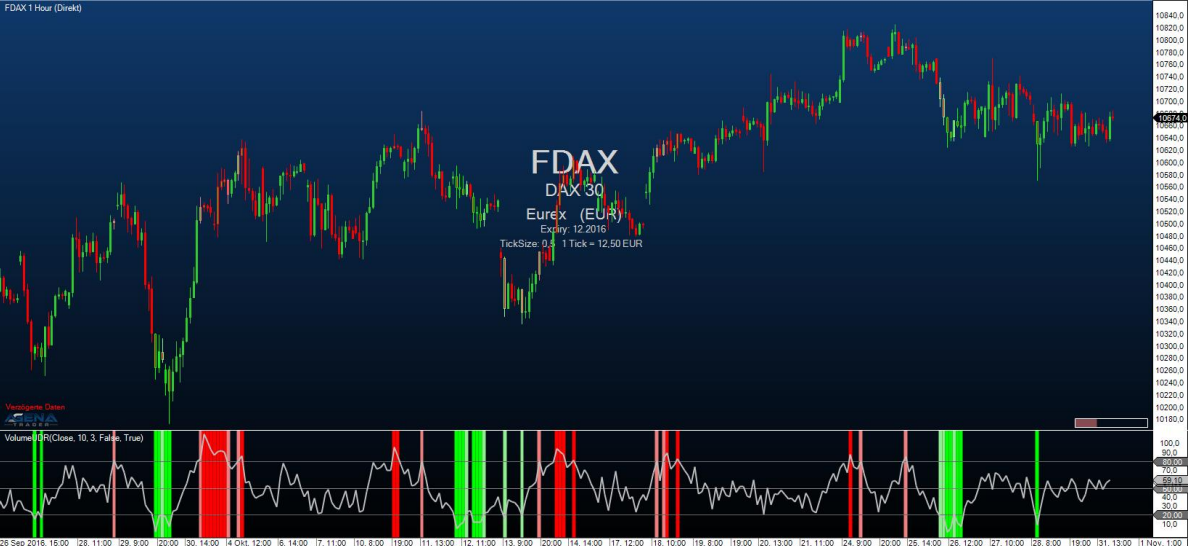
The VolumeUpDownRatio is the relationship between UpVolume and DownVolume, displayed as an oscillator. Volume is classified as UpVolume when the current close of the price candle is located above the close of the prior candle; the opposite applies for DownVolume. Values above 80 are to be graded as a bearish signal; values under 20 as a bullish signal. Besides this, a moving average can be shown, which can serve as an additional signal generator.
* Using “DrawCandleOutline”, you can have the border of your candles colored accordingly when bullish/bearish extreme values occur.
* PriceWeightChange regulates whether you would like to have the weighted change of the market price flow into the calculation of the indicator.
#### Parameters
to be announced
#### Return value
to be announced
#### Usage
to be announced
#### Visualization
#### Example
to be announced